Everybody’s Opening a Cake Pop Stand — But Is It Actually Profitable?
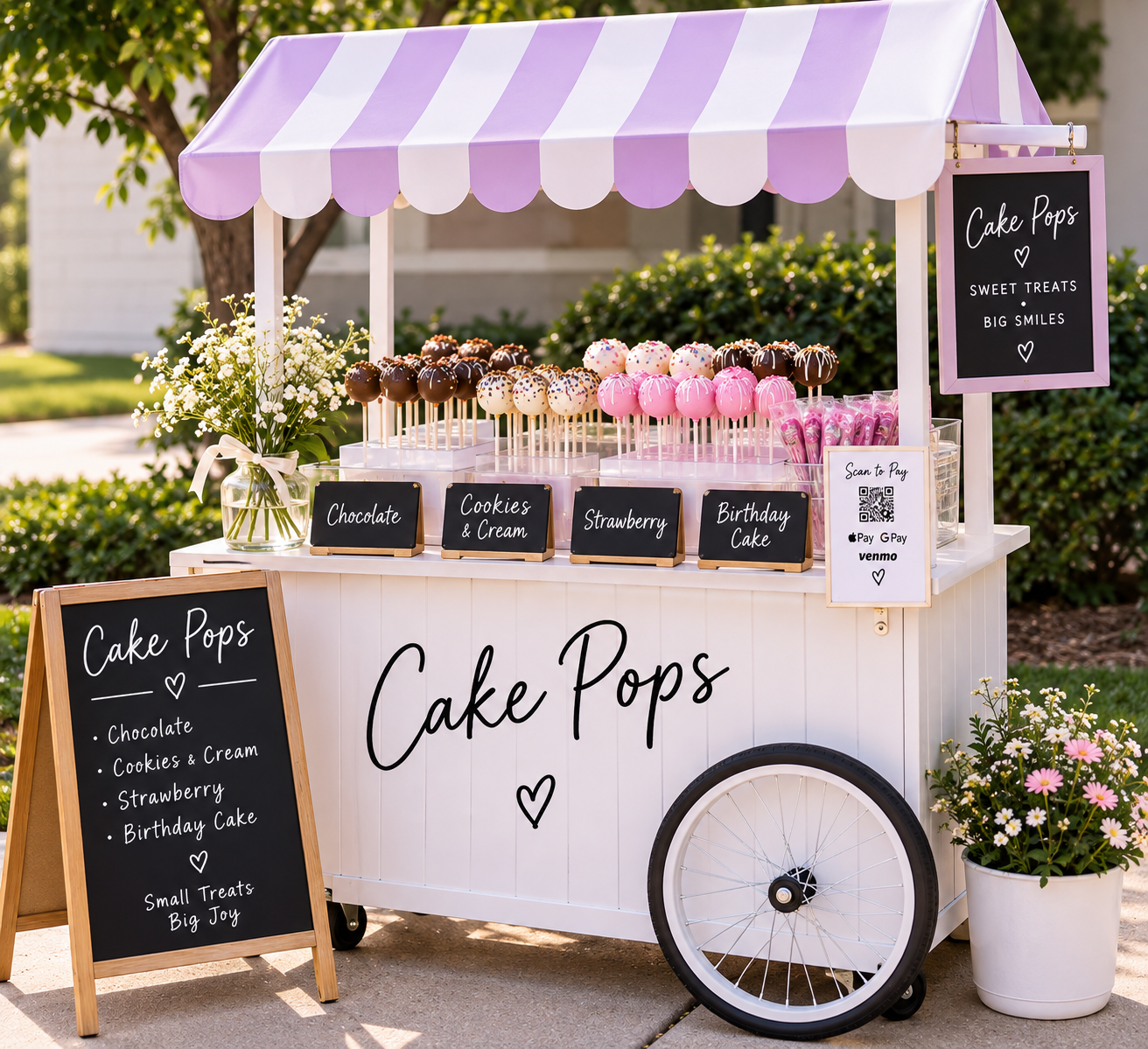
If you’ve been on TikTok lately and you’re anywhere near the baking side of the algorithm, you’ve probably seen them: cake pop stands.
Cute little carts sitting outside someone’s home. Rows of cake pops in different flavors. A sign with a QR code or payment instructions. Grab your cake pops, pay and go.
And listen... I get it. 😂
It’s cute. It catches your attention. It gives customers a way to buy from you without placing a custom order first. And for a treat maker, it can look like a pretty simple way to create another stream of income.
This isn’t just something appearing on our feeds, either. Self-serve cake pop carts have been launching in communities around the country in 2026. Some operate on weekends or specific restock days, rotate their flavors and let customers pay through options like Venmo or cash. One Indiana cake pop seller reported selling 178 cake pops during her opening weekend.
So yes, people are buying.
But Sweet Price is about the business side of making treats, so you already know where my mind goes next:
Is the cake pop stand actually profitable?
Because those are two different questions.
Why are cake pop stands becoming so popular?
The idea makes sense.
Instead of waiting for someone to need 24 custom cake pops for a birthday party three weeks from now, you're creating an opportunity for somebody to buy one today.
Some current cake pop carts are operating right from a home or driveway, while others are taking the concept to local businesses, community events and festivals. Rotating flavors and limited availability can also give customers a reason to check back regularly.
For a treat maker, there's a lot to like about that.
You can test flavors. You can introduce yourself to people in your neighborhood. You can potentially turn somebody who stopped for one $3 cake pop into somebody who remembers your business when they need treats for their next event.
And visually?
Come on. 😂
A cute cake pop cart was basically made for TikTok and Instagram.
But before you order the cart because you saw somebody else's sell out, we need to talk numbers.
First question: What will it actually cost you to start?
The cake pops aren't your only expense.
Depending on the type of setup you're creating, your startup purchases might include the actual cart or stand, paint and decorating materials, signage, cake pop displays, packaging, labels, payment signage or QR-code displays, storage containers, coolers or temperature-control equipment where appropriate, and other supplies.
And then you still have to make the product.
- That means ingredients.
- Coating.
- Sticks.
- Decorations.
- Individual packaging.
- Labels.
- And your time.
This is where a cute idea officially becomes a business investment.
You don't necessarily need the fanciest stand on TikTok to test whether the idea works for you, either. Before spending hundreds of dollars recreating somebody else's setup, ask yourself:
What is the minimum I actually need to test this idea well?
You can always improve the setup as the business proves that it can support the investment.
Please don't forget to pay yourself.
This is the part I don't want getting lost in the trend.
You still have to make all those cake pops.
If you're stocking 50, 75 or 100 cake pops, somebody has to bake the cakes, prepare the filling, form the pops, chill them, melt the coating, dip them, decorate them, package them, label them and stock the stand.
That somebody is you.
Your time didn't suddenly become free because you're selling from a cart instead of filling a custom order.
When calculating what each cake pop costs you, your labor needs to be part of the conversation.
If you aren't accounting for your time, a busy cake pop stand can look a lot more profitable than it actually is.
So... how much should you charge for cake pops?
This is where I'm going to give you the same answer I give treat makers all the time:
I can't tell you your price just because I know what you're selling.
Current self-serve cake pop businesses show prices around the $3 range in some markets, but that doesn't automatically mean your cake pops should be $3.
- Your ingredient costs might be different.
- Your cake pops might be larger.
- Your packaging might cost more.
- Your labor rate might be different.
- Your overhead might be different.
- And your desired profit definitely doesn't have to be identical to somebody else's.
This is exactly why I don't love seeing treat makers ask:
“What would you charge?”
before they know what the product costs them to make.
Someone else's price can tell you something about the market.
It cannot tell you whether that price is profitable for your business.
Know your numbers. Then know your market.
Selling out doesn't automatically mean you made money.
This is probably the biggest thing I want treat makers to remember when watching these businesses online.
“SOLD OUT!” sounds amazing.
And it is exciting.
But selling out tells us that customers bought everything.
It doesn't tell us what was left after everything was paid for.
Imagine you stock your cake pop stand with 100 cake pops and sell every single one.
Great.
Now subtract what it cost to produce those 100 cake pops.
Subtract packaging.
Subtract your labor.
Account for the operating expenses connected to selling them.
Then look at what is actually left.
That's the number I'm interested in.
More customers can multiply a profitable business.
They can also multiply an unprofitable one.
What happens when you DON'T sell out?
We also have to talk about the less exciting weekend.
What if you make 100 cake pops and only sell 46?
What happens to the other 54?
Can they safely be sold another day? How does that fit with your product quality standards? Will some become waste? How much money is sitting in unsold inventory?
The answers will depend on your products, ingredients, storage practices and applicable food-safety rules, but financially, unsold product matters.
This is why I wouldn't decide how much inventory to make just because another cake pop cart on TikTok stocked 100.
Start collecting your own data.
- How many did you stock?
- How many sold?
- Which flavors sold first?
- Which barely moved?
- What days and times brought the most customers?
- Did you sell out because demand was incredible—or because you intentionally stocked a small amount?
Those numbers can help you make a much smarter decision the next time you restock.
Don't forget the legal side either.
A self-serve stand sitting in your driveway doesn't automatically mean you can sell whatever you want from it.
Home-based and cottage food rules vary by state and locality, including which foods may be sold, labeling requirements, food-safety requirements and where or how products can be sold.
For example, the two Indiana sellers featured in a recent report said they followed their state's home-based vendor requirements, including labeling, food-safety practices and food-handler certification.
So before launching yours, check the rules that actually apply where you live.
TikTok is inspiration.
It is not your local health department. 😂
The stand sold out. But has the stand paid for itself?
Now we're getting to the part I REALLY want you thinking about.
Let's say you spent $450 getting your cake pop stand ready.
Between the stand itself, displays, signage and other startup purchases, you're $450 invested before your first customer ever walks up.
Your first weekend goes great.
You bring in $200 in sales.
Did you make $200 toward your $450 investment?
Not necessarily.
You still had costs associated with producing what you sold.
That's why I want you separating sales, profit and investment payoff in your head.
Your sales tell you how much money came in.
Your costs tell you what it took to produce and operate.
Your profit helps tell you what the business actually earned.
And tracking your startup investment helps you answer another question:
Has this thing paid for itself yet?
This is one thing I appreciate about Sweet Price.
I built Sweet Price because I wanted treat makers to be able to see more than money coming into their account.
When you're setting up the business side of Sweet Price, you can account for equipment and startup purchases and track their payoff as you log your sales.
So if that new cake pop stand cost you money to launch, I don't just want you celebrating every time the stand brings in another $100.
I want you to eventually be able to look at your numbers and say:
“That stand officially paid for itself.”
And then celebrate. 😂🥂
Because that's different.
The goal isn't to take the fun out of trying something trendy. Try the thing. Create the cute stand. Make the TikToks. Test the crazy flavors. Get excited when somebody pulls up and buys six cake pops.
I just want the numbers to be as cute as the stand.
That's it. 😂
Know your costs. Know your price. Track your sales. Watch your investment come back.
That's how a trend has the opportunity to become something that actually makes sense for your business.
Have you used Sweet Price to price your desserts?
Share your experience with the Sweet Price community.
Frequently asked questions
Are cake pop stands profitable?
They can be, but simply selling cake pops doesn't guarantee a profit. Profitability depends on your selling price compared with your ingredient costs, packaging, labor, operating expenses, unsold inventory and startup investment. Track what actually comes in and goes out before deciding whether your stand is profitable.
How much should I charge for cake pops?
There isn't one price that works for every cake pop business. Calculate your ingredient cost, packaging, labor and relevant business expenses first, then determine the profit you need. After you know your numbers, you can compare your price with cake pop prices in your market.
How much does it cost to start a cake pop stand?
Startup costs vary widely depending on the setup. Consider the stand or cart itself, displays, signage, packaging, labels, payment setup, storage or temperature-control needs, decorating materials and your initial inventory. Starting with a simpler setup can also let you test demand before making a larger investment.
How many cake pops should I make for a self-serve stand?
There isn't a universal number. Consider starting with a manageable quantity and tracking how many sell, which flavors perform best, what days are busiest and how much product remains. Your own sales history can eventually help you make better inventory decisions than copying another seller's quantities.
What costs should I include when pricing cake pops?
Consider ingredients, coating and decorations, sticks, individual packaging, labels, labor and relevant business overhead or operating expenses. Your specific business may have additional costs that should be accounted for.
How do I know when my cake pop stand has paid for itself?
Keep your startup investment separate from sales revenue. Track what you originally spent to launch the stand and how much money the business generates after the costs associated with producing and selling your products. Sweet Price's equipment and startup purchase tracking is designed to help business owners follow the payoff of those investments as they log sales.
Related reading
Ready to price your products with confidence?
Sweet Price OS gives you inventory, recipe costing, and a pricing calculator in one place. Free to start.
Educational estimates and organizational tools, not financial, legal, or tax advice.